Hyderabad is situated 5 km from the eastern bank of the River Indus in Sind, Pakistan. The site upon which the city now stands is thought to date back to pre-historic times when the nearby hills were used as a place of worship. Hyderabad was occupied before the 8th century but the modern city was founded in 1768 by Ghulam Shah Kalhora and remained the emirs capital until the British general Sir Charles Napier conquered Sind in 1843.


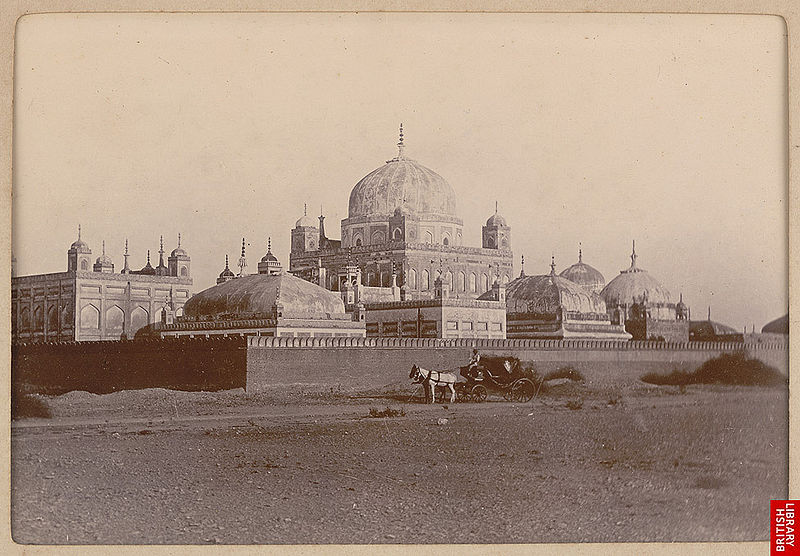
Above Photograph of the tombs of the Talpur Mirs at Hyderabad in the Sindh province now in Pakistan, taken by an unknown photographer, c.1900, from an album of 46 prints titled ‘Karachi Views’. Sindh province takes its name from the Sindhu river which flows through it, frequently flooding its banks, and known to the West as the mighty Indus. Sindh has a long history, and the Talpur Mirs, originally from Baluchistan, were the last of the dynasties which ruled Sindh. Reigning from 1782-1843, their capital was Hyderabad. The city had been chosen as the capital of the Kalhora rulers of Sindh in the 1760s. When they were displaced by the Baluchi Talpurs in 1782, Hyderabad remained the capital of Sindh. The Talpurs were defeated by the British in 1843, and the capital of Sindh was shifted to Karachi. The tombs of both the Kalhoras as well as the Talpurs lie on a ridge north of the old city of Hyderabad, although the latter’s are better preserved. An oblong wagon vault is used for the smaller tombs and different levels are defined by low parapets.
 The History